
- Sep 20, 2025
Waterfall vs. Agile: A Hybrid Approach to Scope Management and Iterative Delivery
Project management methodologies continue to evolve, yet the debate between Waterfall and Agile remains central to how organizations deliver projects. Each methodology offers unique advantages, but when it comes to scope management and ensuring business value, a hybrid approach often delivers the best results. Specifically, Waterfall provides the structure and control needed for managing scope, while Agile can be leveraged within those Waterfall phases to iterate, refine, and adapt deliverables.
Waterfall for Scope Management
Scope creep is one of the most common challenges project managers face. In projects with significant complexity, regulatory requirements, or high stakeholder expectations, Waterfall’s structured, sequential phases - initiation, planning, execution, monitoring, and closure - offer unmatched clarity and control.
Defined deliverables: By locking down scope early, project teams and stakeholders have a clear, shared understanding of the project’s outcomes
Predictability: Milestones and deliverables are mapped out in advance, reducing ambiguity and allowing precise resource allocation
Accountability: The linear process ensures ownership of each phase, making it easier to manage dependencies and approvals
For industries such as construction, engineering, or large-scale IT infrastructure, Waterfall remains the gold standard for scope discipline, where ambiguity in deliverables could translate into cost overruns and delays.
Agile for Iterative Progress
While Waterfall sets the framework, Agile brings flexibility into the execution layers. Instead of treating each deliverable as a monolith, Agile practices, such as working in sprints, conducting regular retrospectives, and adapting based on feedback, allow teams to build, test, and improve incrementally.
Early value delivery: Even within a larger Waterfall milestone, Agile iterations produce tangible outputs faster, providing stakeholders with visible progress
Continuous improvement: Iterative cycles create opportunities for feedback and refinement before the final product is delivered
Team empowerment: Agile fosters collaboration, self-organization, and adaptability, which boosts morale and innovation
This is especially valuable in areas such as software development, UX/UI design, and prototyping, where requirements may evolve rapidly, even if the broader project scope is fixed.
The Hybrid Model: Waterfall Framework, Agile Execution
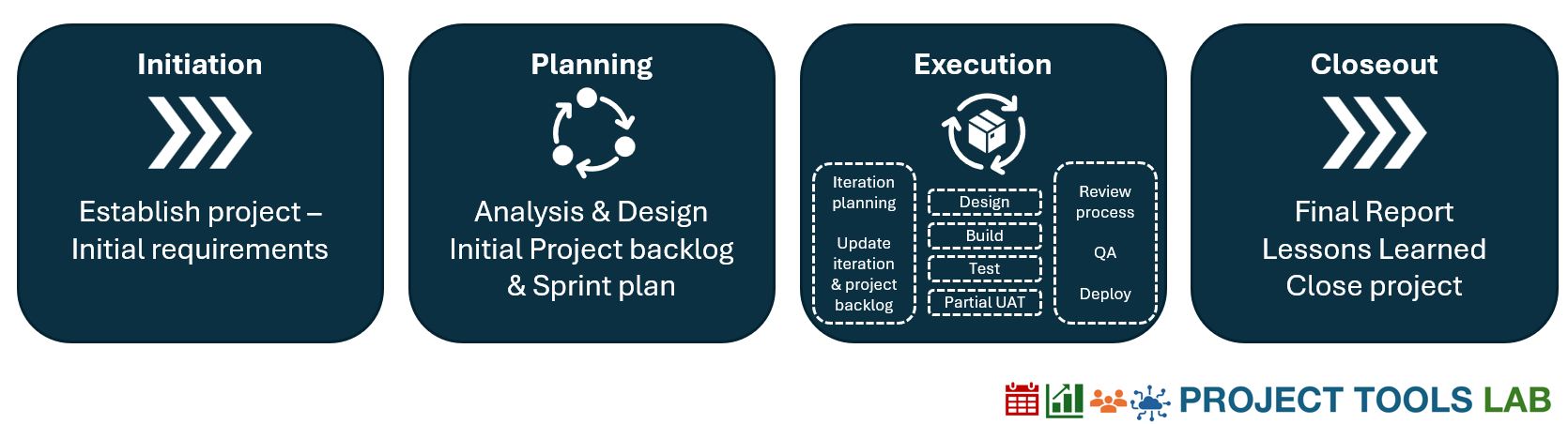
The best of both worlds emerges when project managers use Waterfall as the overarching methodology to manage scope, while embedding Agile practices within phases to iterate deliverables.
How It Works:
-
Initiation & Planning (Waterfall)
Define scope, objectives, constraints, and success criteria
-
Develop the Work Breakdown Structure (WBS) and establish clear baselines
-
Execution (Agile within Waterfall)
Break down large deliverables into smaller increments
Run Agile sprints within the defined scope, delivering usable outputs frequently
-
Use sprint reviews and retrospectives to adapt outputs without shifting the agreed-upon scope
-
Monitoring & Control (Waterfall)
Ensure adherence to scope, budget, and timeline
-
Track changes formally through change control boards (CCBs), balancing flexibility with discipline
-
Closure (Waterfall)
Validate that all deliverables align with the original scope
Incorporate Agile-driven insights into lessons learned
Why Project Managers Should Embrace This Hybrid
For project managers, the hybrid model is not about choosing sides, but about leveraging both methodologies where they excel.
Waterfall ensures the scope is protected and aligned with business strategy
Agile ensures the work within that scope is adaptive, innovative, and responsive to stakeholder feedback
Ultimately, this approach reduces risk, increases stakeholder satisfaction, and improves delivery outcomes. In today’s complex project environments, project managers who can blend Waterfall’s structure with Agile’s adaptability position themselves, and their projects, for long-term success.
Key Takeaway
Use Waterfall to manage scope at the project level, but apply Agile to drive iterative progress within phases. This combination ensures discipline without sacrificing innovation.